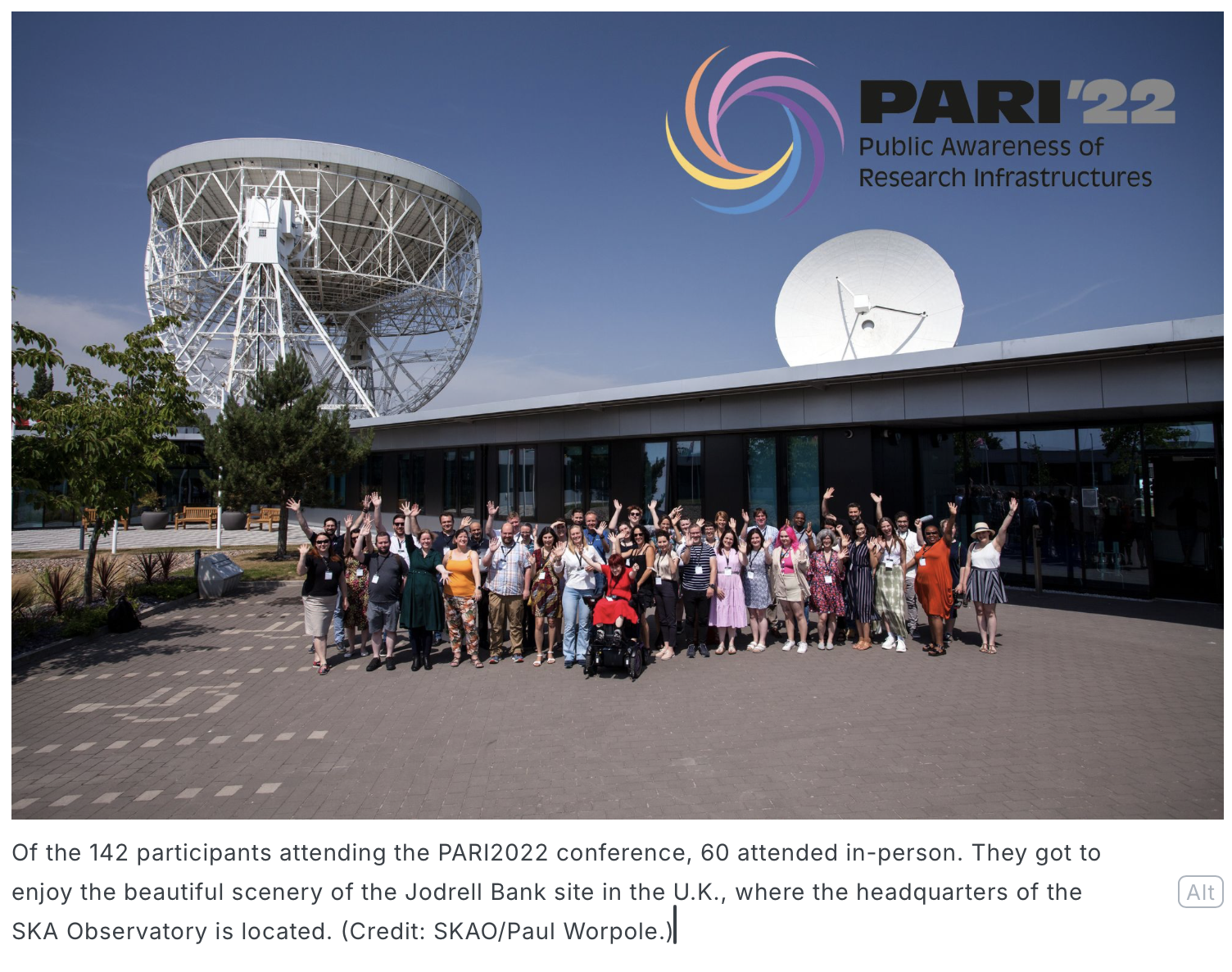
The Public Awareness of Research Infrastructures (PARI) three-day conference held in July 2022 at the SKA Observatory’s Global Headquarters (U.K.) discussed the science communication issues that practitioners face at research infrastructures, like community building, science diplomacy and equity, diversity and inclusion in STEM. We concluded that we need to bring society within the walls of the scientific facilities as much as we need to help scientists engage with society.
This article was originally published in the Journal of Science Communication, to be cited as:
Nuijens, F. (2022). Bringing society inside the walls of scientific facilities. JCOM 21(06), R08. https://doi.org/10.22323/2.21060608
SKAO’s director-general Prof. Philip Diamond set the tone for the conference in his opening speech by reminding us that research infrastructures should always consider how the fruits of their scientific labour flow back to society. The SKAO’s work in radio astronomy, for example, contributes to 11 of the 17 sustainable development goals. Making clear that fundamental research benefits both science and society in many ways.
Audiences
Reaching audiences with no or low science capital was a recurring topic of interest. At the Jodrell Bank Centre for Engagement, director Prof. Teresa Anderson explained, they position science as part of culture, emphasising the ‘wow-factor’ and inspiring visitors of the annual festival of music, art and science, bluedot. The CERN microcosm exhibition taught the communications team that especially young visitors are enthused most by the location where the science happens, the actual labs, and meeting the scientists themselves, even if they aren’t stellar communicators. This was an important realisation because science relies on diversity in the backgrounds of scientists to generate new ideas and new perspectives, CERN’s Emma Sanders explained.
The persistence of the deficit model amongst science communicators makes it difficult to reach the people who might benefit most from science dialogue and engagement. More training in communication theory and skills is needed — and that means that institute and university administrators need to realise that simply because a scientist can talk, doesn’t necessarily mean they can communicate effectively with non-expert audiences.
One of the most important stakeholders for research infrastructures are the scientists who use their facilities. To engage and facilitate them, many research infrastructures are working on community building strategies. ASTRON’s Elise Brouwer discussed how LOFAR, the world’s largest low-frequency radio telescope, plans to move its community of active users from an institution-driven community to a community-led organisation. Adelle Coote from the Australian Research Data Commons (ARDC) shared her process of involving stakeholders, where the major challenge is to make something intangible like data services and expertise concrete.
EDI and sustainability
Another very important aspect in reaching a more diverse population with science communication is the growing attention towards equity, diversity and inclusion (EDI) in STEM. This matters not only because everyone deserves equal opportunities for a career in science, but also because audiences with low or no science capital need to recognise themselves in the scientists they meet.
One of the inspirational role models at PARI 2022 was keynote speaker Dr. Claire Malone. As a physicist with cerebral palsy, she showed that being a good science communicator doesn’t need to be hampered by a physical disability. She linked her physics work on the Standard Model to her own challenges, comparing so-called invisible particles to the invisibility of the LGBTQIA+ community in STEM. Malone reiterated the message that science needs more diversity in its role models, adding that everyone can be a role model for someone.
Sustainability is also top of mind for many research infrastructures. EMBL (Germany) has an ambitious sustainability strategy outlining how they want to reduce their environmental impact by 2030. Tabea Rauscher showed the many communication activities developed to support the implementation of the strategy, using the Laboratory Efficiency Assessment Framework to enable behavioural change through targeted communication and empowerment.
Science diplomacy
Research infrastructures also play an important role in science diplomacy, as highlighted by keynote speaker Dr. Marga Gual Soler. She distinguished three types: 1) diplomacy for science, where cooperation between scientists and countries is established to facilitate large-scale science, 2) science in diplomacy, where science helps tackle meta issues like food shortages and the energy transition, and 3) science for diplomacy, where science facilitates peace by keeping lines of communication open between countries at odds — the Jordan-based SESAME particle accelerator being one such example.
Several speakers highlighted the need to work closely with local communities in South Africa and Western Australia around the construction of the SKA telescopes. SARAO’s Anton Binneman explained how using critical discourse analysis to look at the frames and narratives used by community groups can be an important part of the stakeholder engagement process.
In his closing remarks, conference host Mathieu Isidro from the SKAO highlighted how communicating the wider impact of research infrastructures in society is becoming more important, perhaps even more than communicating the science itself. Together, scientists and science communication professionals can — and should — help deconstruct the proverbial ivory tower of science, brick by brick, and build instead a forum where a wide range of issues can be discussed openly.
References
Anjos, S., Russo, P. & Carvalho, A. (2021). Communicating astronomy with the public. JCOM 20(03), A11. doi:10.22323/2.20030211
Entradas, M. & Bauer, M. W. (2019). Bustling public communication by astronomers. Nature Astronomy 3(2), 183–187. doi:10.1038/s41550-018-0633-7
Scheufele, D. A. (2022). Thirty years of science-society interfaces. Public Understanding of Science 31(3), 297–304. doi:10.1177/09636625221075947
De driedaagse PARI-conferentie (Public Awareness of Research Infrastructures) die in juli 2022 plaatsvond op het wereldhoofdkwartier van de SKA Observatory (VK) besprak de wetenschapscommunicatievraagstukken waar beoefenaars bij onderzoeksinfrastructuren mee te maken hebben, zoals community building, wetenschapsdiplomatie en diversiteit, gelijkheid en inclusie in STEM. We concludeerden dat we de samenleving net zo goed binnen de muren van de wetenschappelijke faciliteiten moeten brengen als dat we wetenschappers moeten helpen om met de samenleving in gesprek te gaan.
Dit artikel werd oorspronkelijk gepubliceerd in het Journal of Science Communication, te citeren als:
Nuijens, F. (2022). Bringing society inside the walls of scientific facilities. JCOM 21(06), R08. https://doi.org/10.22323/2.21060608
SKAO-directeur-generaal prof. Philip Diamond zette de toon voor de conferentie in zijn openingsrede door eraan te herinneren dat onderzoeksinfrastructuren altijd moeten nadenken over hoe de vruchten van hun wetenschappelijke arbeid terugvloeien naar de samenleving. Het werk van SKAO in de radioastronomie draagt bijvoorbeeld bij aan 11 van de 17 duurzame ontwikkelingsdoelen. Dit maakt duidelijk dat fundamenteel onderzoek op vele manieren zowel de wetenschap als de samenleving ten goede komt.
Doelgroepen
Het bereiken van doelgroepen met weinig of geen wetenschappelijk kapitaal was een terugkerend aandachtspunt. Bij het Jodrell Bank Centre for Engagement positioneren ze wetenschap als onderdeel van cultuur, met nadruk op het ‘wow-effect’ en het inspireren van bezoekers van het jaarlijkse festival van muziek, kunst en wetenschap, bluedot. De CERN microcosm-tentoonstelling leerde het communicatieteam dat vooral jonge bezoekers het meest enthousiast worden van de locatie waar de wetenschap plaatsvindt, de echte laboratoria, en van ontmoetingen met de wetenschappers zelf.
Het voortbestaan van het deficit model onder wetenschapscommunicatoren maakt het moeilijk om de mensen te bereiken die het meest baat zouden hebben bij wetenschapsdialoog. Er is meer training in communicatietheorie en -vaardigheden nodig — en dat betekent dat bestuurders van instituten en universiteiten moeten beseffen dat het feit dat een wetenschapper kan praten, niet noodzakelijkerwijs betekent dat hij of zij effectief kan communiceren met een niet-expert publiek.
ASTRON’s Elise Brouwer besprak hoe LOFAR, 's werelds grootste lagefrequentie-radiotelescoop, van plan is zijn gemeenschap van actieve gebruikers te verschuiven van een institutioneel gestuurde gemeenschap naar een door de gemeenschap geleide organisatie.
EDI en duurzaamheid
Een ander belangrijk aspect bij het bereiken van een diverser publiek is de groeiende aandacht voor gelijkheid, diversiteit en inclusie (EDI) in STEM. Dit is niet alleen van belang omdat iedereen gelijke kansen verdient op een carrière in de wetenschap, maar ook omdat doelgroepen met weinig of geen wetenschappelijk kapitaal zichzelf moeten kunnen herkennen in de wetenschappers die ze ontmoeten.
Een van de inspirerende rolmodellen op PARI 2022 was keynotespreker dr. Claire Malone. Als natuurkundige met cerebrale parese liet ze zien dat een lichamelijke beperking geen belemmering hoeft te zijn voor wetenschapscommunicatie. Ze legde een verband tussen haar werk aan het Standaardmodel en de onzichtbaarheid van de LGBTQIA+-gemeenschap in STEM. Malone herhaalde de boodschap dat de wetenschap meer diversiteit in haar rolmodellen nodig heeft.
Duurzaamheid staat ook hoog op de agenda van veel onderzoeksinfrastructuren. EMBL (Duitsland) heeft een ambitieuze duurzaamheidsstrategie om de ecologische voetafdruk vóór 2030 te verkleinen. Tabea Rauscher liet de vele communicatie-activiteiten zien die zijn ontwikkeld om de implementatie van de strategie te ondersteunen.
Wetenschapsdiplomatie
Onderzoeksinfrastructuren spelen ook een belangrijke rol in wetenschapsdiplomatie, zoals benadrukt door keynotespreker dr. Marga Gual Soler. Zij onderscheidde drie typen: 1) diplomatie vóór wetenschap, 2) wetenschap in diplomatie, en 3) wetenschap vóór diplomatie, waarbij wetenschap vrede faciliteert door communicatielijnen open te houden tussen landen die het oneens zijn — de in Jordanië gevestigde SESAME-deeltjesversneller is daarvan een voorbeeld.
In zijn slotopmerkingen benadrukte conferentiegastheer Mathieu Isidro van SKAO hoe het communiceren van de bredere impact van onderzoeksinfrastructuren in de samenleving steeds belangrijker wordt, misschien zelfs meer dan het communiceren van de wetenschap zelf. Samen kunnen wetenschappers en wetenschapscommunicatieprofessionals — en dat zouden ze moeten — de spreekwoordelijke ivoren toren van de wetenschap steen voor steen helpen afbreken en in plaats daarvan een forum bouwen waar een breed scala aan onderwerpen openlijk besproken kan worden.